How we run go-to-market with agents, and why we don't use them to send more email
Agents write almost every change to our sales system. We use them to research each company before we write to it, not to send more mail. Here is how the system works and the rules our CEO wrote into it.
Most of our go-to-market work runs through coding agents. Since June 2026, almost every change to our sales repository has been written together with an agent.1 Almost all of those changes came from our CEO, Yoichi Goto, working through agent sessions.1
The obvious use for that much automation is volume: more lists, more emails, more follow-ups. We decided against it. Our CEO wrote the reason into the rules every draft is checked against:
Cold outreach is not sending a lot of email to people you don't know. First you study the other company's business and what it publishes, and think concretely about what problems it may have. Then you tell them only what we can actually fix, in their terms. AI can find well-matched companies and people and write to each one in context. But the goal is not to send more. The goal is that each message makes clear why we are writing to this person, and why now.2
This post is about how that idea became a working system, and what changed our mind along the way.
Every rule records its reason
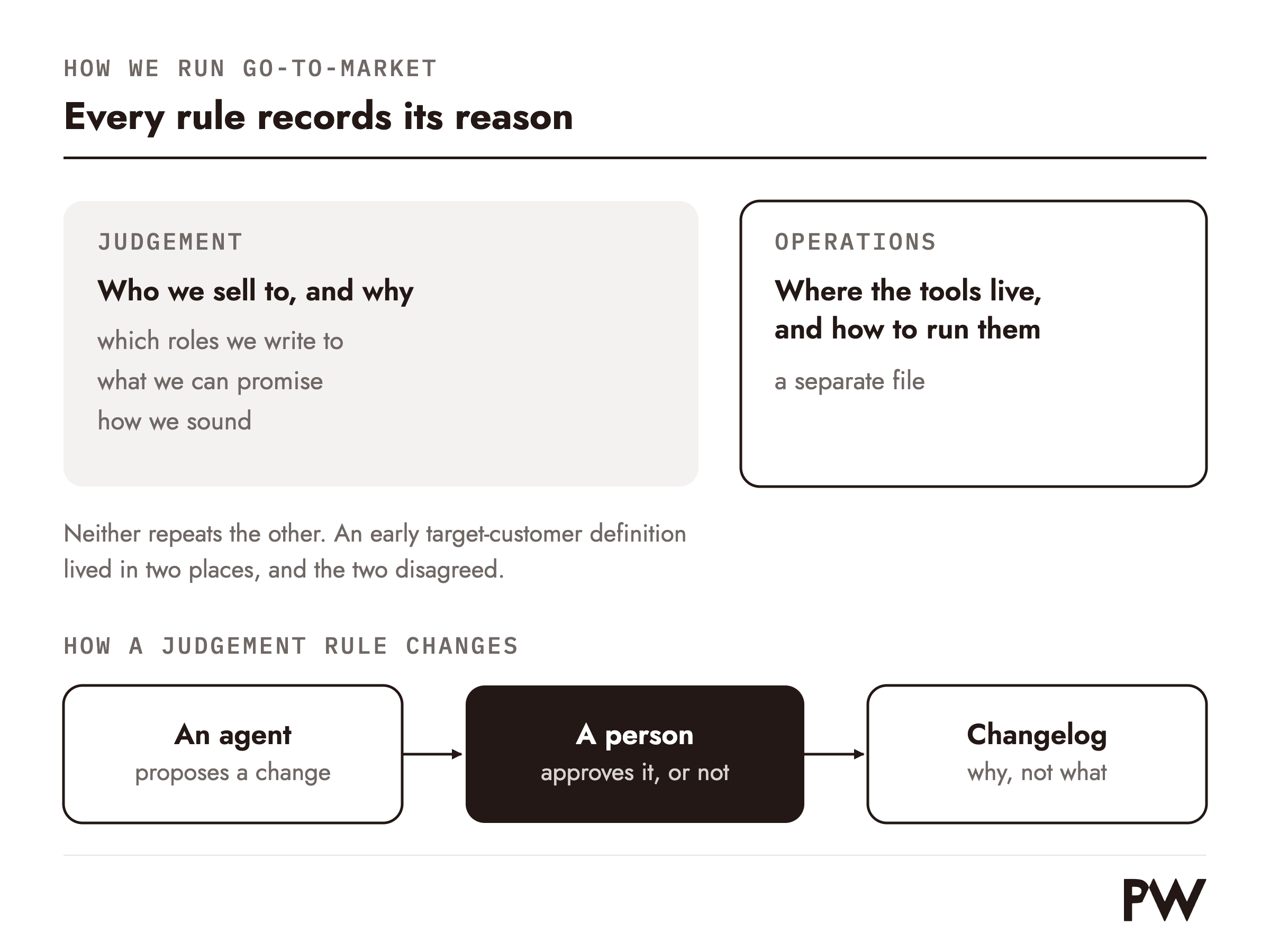
The repository keeps two kinds of knowledge apart. One folder holds judgement: who we sell to, which roles we write to, what we can promise and how we sound. A separate file holds operations: where the tools live and how to run them. Neither repeats the other, because an early version of our target-customer definition existed in two places and the two disagreed.1
Every change to the judgement folder goes into a changelog with one rule at the top: write why you changed it, not what you changed.3 Agents may propose a change at the end of a task, but they cannot write it until a person approves it.1
That changelog is the most useful file we have. It is where the thinking behind the system lives.
What the changelog taught us
Here are some of the decisions in it, with the reasons as they were written down.
Measure the company, not the industry label. In August we measured a set of manufacturers on two things: how many product model numbers people search for, and how many product pages a machine can actually read. Industry labels gave the wrong answer. One company filed as "no public catalog" had hundreds of real catalog pages. Some large makers had many searched model numbers and almost no readable product pages. The rule became: a small public catalog is not a reason to drop a company. It can be the strongest reason to write.3
Never write "couldn't reach" as zero. A few company sites blocked our crawler, and the pages we could not load were recorded as "no catalog". That number would have gone straight into a report and an email. Unmeasured is now recorded as unmeasured.3
Say the number the way the reader will read it. A growth rate reads as good news to an executive, even when a competitor is far ahead. An absolute gap against a named competitor reads as a problem worth solving. We changed the opening line from one to the other.3
The email must agree with the report. In one draft the headline number was a low score. But the report we had promised to send said the company was ahead of its peers. A reader who finds the email and page one of the report disagreeing stops trusting every other number. The score came out of the email.3
If you cannot write a true reason, write none. Our outreach tool sends one email body per campaign, so a sentence about why we are writing has to be true for everyone on that campaign. When it could not be, the agent's fallback was to reword the person's job title. That reads as machine-written and gets deleted. The rule now is to leave the sentence out.3
Weak evidence softens the claim, it does not stop the email. When the data for a company is thin, the email makes a smaller claim that is still measured. Cutting the company from the list loses more than a less striking email does.3
Sell more, not save more. Over three months our pitch moved from cost reduction to new business from better catalog data. An advisor put it simply: everyone says savings matter, but what people really want is to sell more. The same week we heard the same point in another outside conversation and in our own team review.3
Don't pick the winning email too early. In September, the number of people enrolled in live campaigns was too small to compare reply rates between versions of an email, so we wrote down a rule: no version is kept or dropped on reply rate until the sample is large enough.3
How a message gets made
The pipeline today, in general terms:
- Pick the companies. A written screening guide turns our target-customer definition into ordered gates, with only four verdicts: pass, exclude, lower priority and hold. It includes a table of the mistakes we kept making, such as judging fit by whether a site has a chatbot. It exists so that people other than the CEO can do the screening.4
- Find the gap. Before we write, an agent checks the company's public product information: whether AI search engines answer questions about its products correctly, compared against the official datasheets, and whether its own product pages hold the specs a buyer compares on.1 What we find becomes the first lines of the email.
- Research the account. Each company gets a folder: sources, analysis, and a short proposal. In busy weeks our agents open research folders on many companies at once, each with its own sources.1
- Draft and check. Agents write the drafts. A checker reviews every one against the written rules before a person sees it. A draft that could be sent to another company by swapping the name is rejected. So is any claim that was not measured from public documents.2
- A person approves. A single router decides which skills a request needs and prints the route before it starts. Every route that sends something ends with a stop for human approval.1 Contacts are loaded into campaigns that stay in draft and send nothing until they are reviewed.1
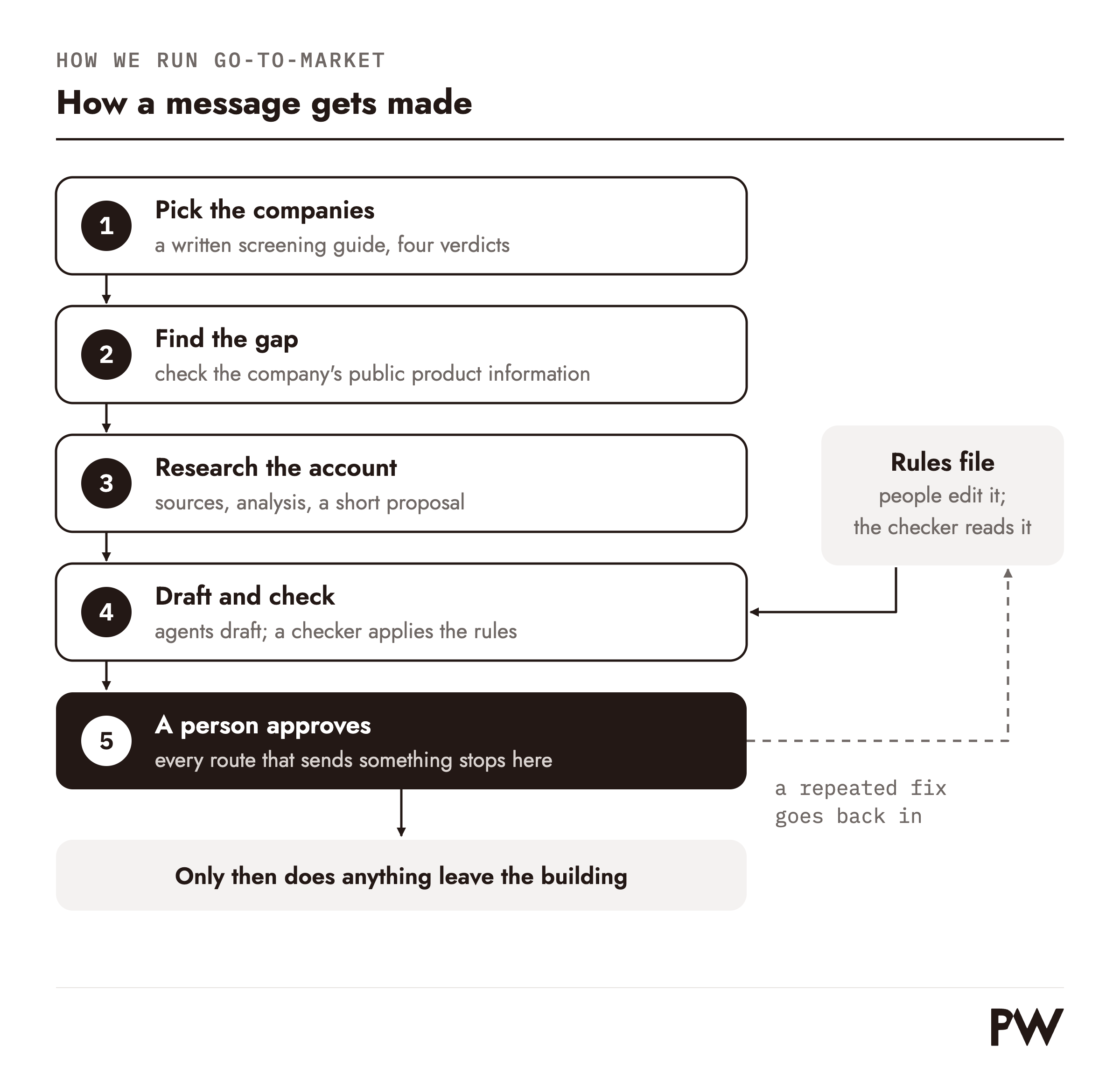
When a review keeps fixing the same thing, the fix goes back into the rules file, so the next automatic check catches it. Our deck checker, for example, reads its list of banned phrases from the same file people edit, built from past review comments.3
What happened
The early results are small, and we say so.
From mid-August to late October, broad campaigns brought very few replies with genuine interest.5 From late October we wrote to each sector and each trade show specifically: emails built around gaps we had found in that company's own public product information, tied to a building regulation or to a trade show it was exhibiting at. In the next two weeks, more companies replied than in the whole period before, from far fewer emails.5 Some of those replies have already become meetings.5
A handful of replies is not a reply rate. By our own September rule, it is an early signal and nothing more. We will publish the real numbers when the sample is large enough to mean something.
What we would tell another team
- Write the reason for every rule next to the rule. The reasons are what let a new person, or a new agent, make the next call.
- Use agents to make each message more specific, not to make more messages.
- Keep a person at the point where something leaves the building.
- Don't trust a reply rate built on a few dozen people. Including ours.
Sources
-
Pioneerwork go-to-market repository, commit history and documentation, June to November 2026 (internal). ↩ ↩2 ↩3 ↩4 ↩5 ↩6 ↩7 ↩8
-
Pioneerwork, "Email review rules", go-to-market knowledge base, 2026-11-08 (internal). Quoted passage translated from Japanese and shortened. ↩ ↩2
-
Pioneerwork, go-to-market knowledge base changelog, August to November 2026 (internal). ↩ ↩2 ↩3 ↩4 ↩5 ↩6 ↩7 ↩8 ↩9 ↩10
-
Pioneerwork, "Target-customer screening guide", go-to-market knowledge base, 2026-10-30 (internal). ↩
-
Pioneerwork outreach records, emails sent and replies received, 2026-08-17 to 2026-11-08 (internal). "Replied" counts companies where a person answered, excluding auto-replies, newsletters and bounces. ↩ ↩2 ↩3